Designers Are the New Product Managers
Open design roles hit a record low while PM roles keep growing. The lines were always blurry. Design was never separate from business.
What is a Product Manager? The person who sits in meetings with stakeholders, discusses how the product is performing and what is worth building next, assesses the roadmap and resources, talks to customers, and then writes a PRD or a prototype and gives direction.
I’ve found myself doing that for the last three years. Some roles in tech are very blurred. So am I, as a designer, the new Product Manager?
In my client engagements I always talk to the founders or the CEO. I try to understand what we are solving and what needs to be achieved in terms of metrics. Then I build it with engineers and track it. So am I a product manager? A designer? An engineer?
The charts look scary
Twice a year, Lenny Rachitsky digs into tech hiring. His late 2026 report came out on 10 November, and his post about it on X passed 650,000 views. For designers, the headline is rough.
Open design roles at tech companies are at a record low: 1,924, just under the previous low of 1,957 in December 2023, and far from almost 5,000 in August 2022. There are now 3.8 open PM roles for every open design role. In early 2023 it was 1.9.
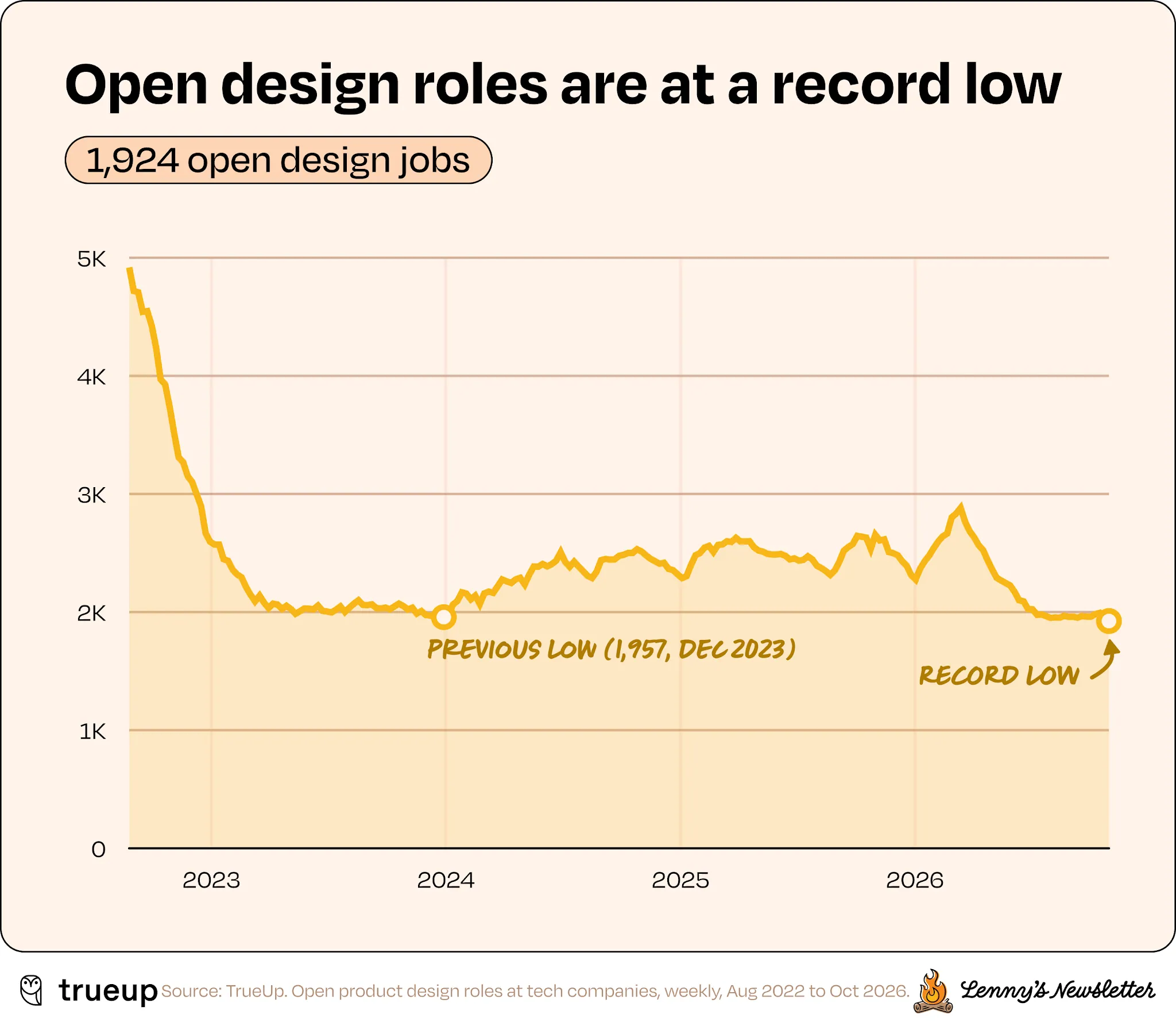
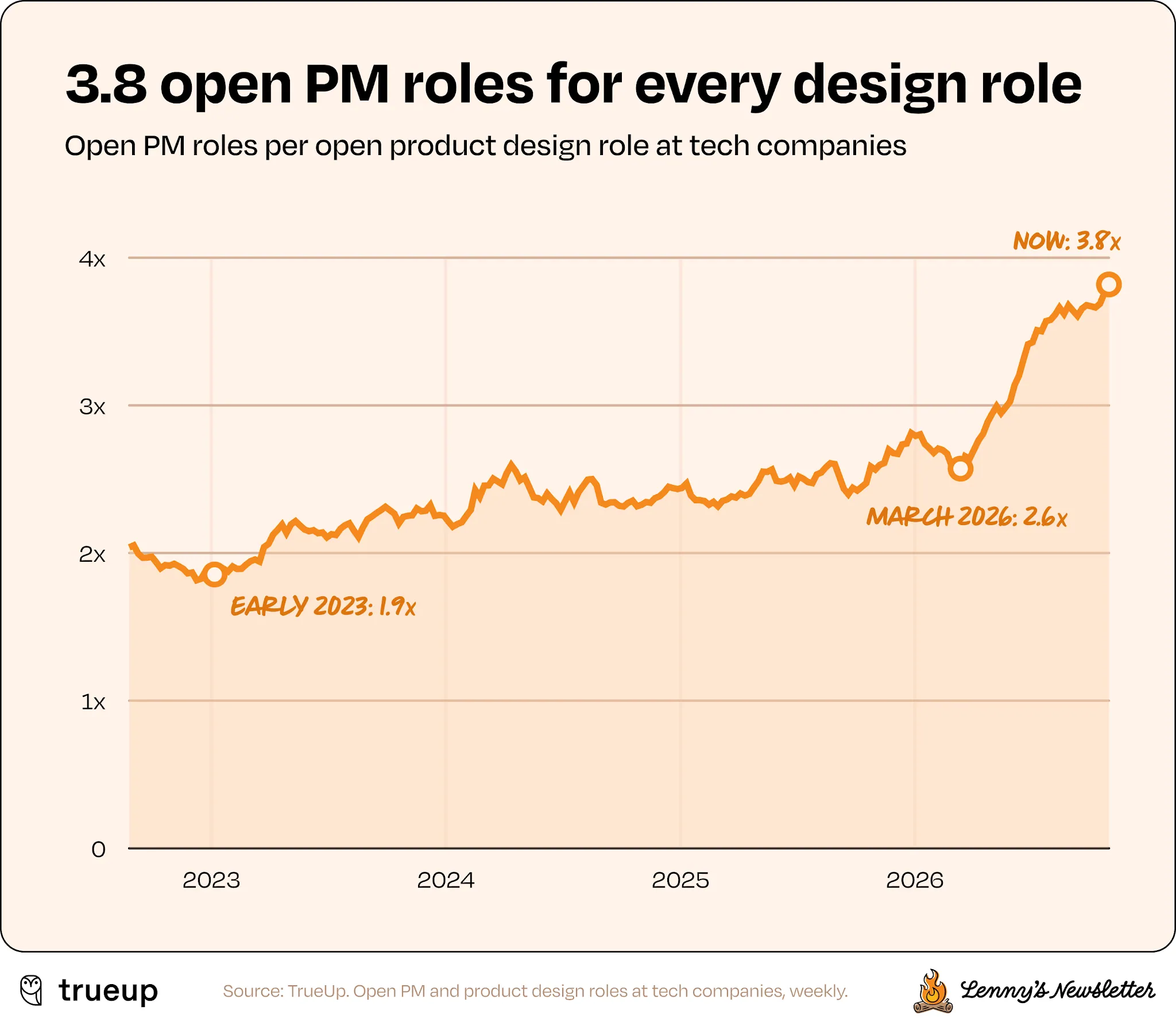
These graphs can look scary. But they only show that the lines have always been blurry. Design was never separate from business. It always was business.
Then who are recruiters hiring?
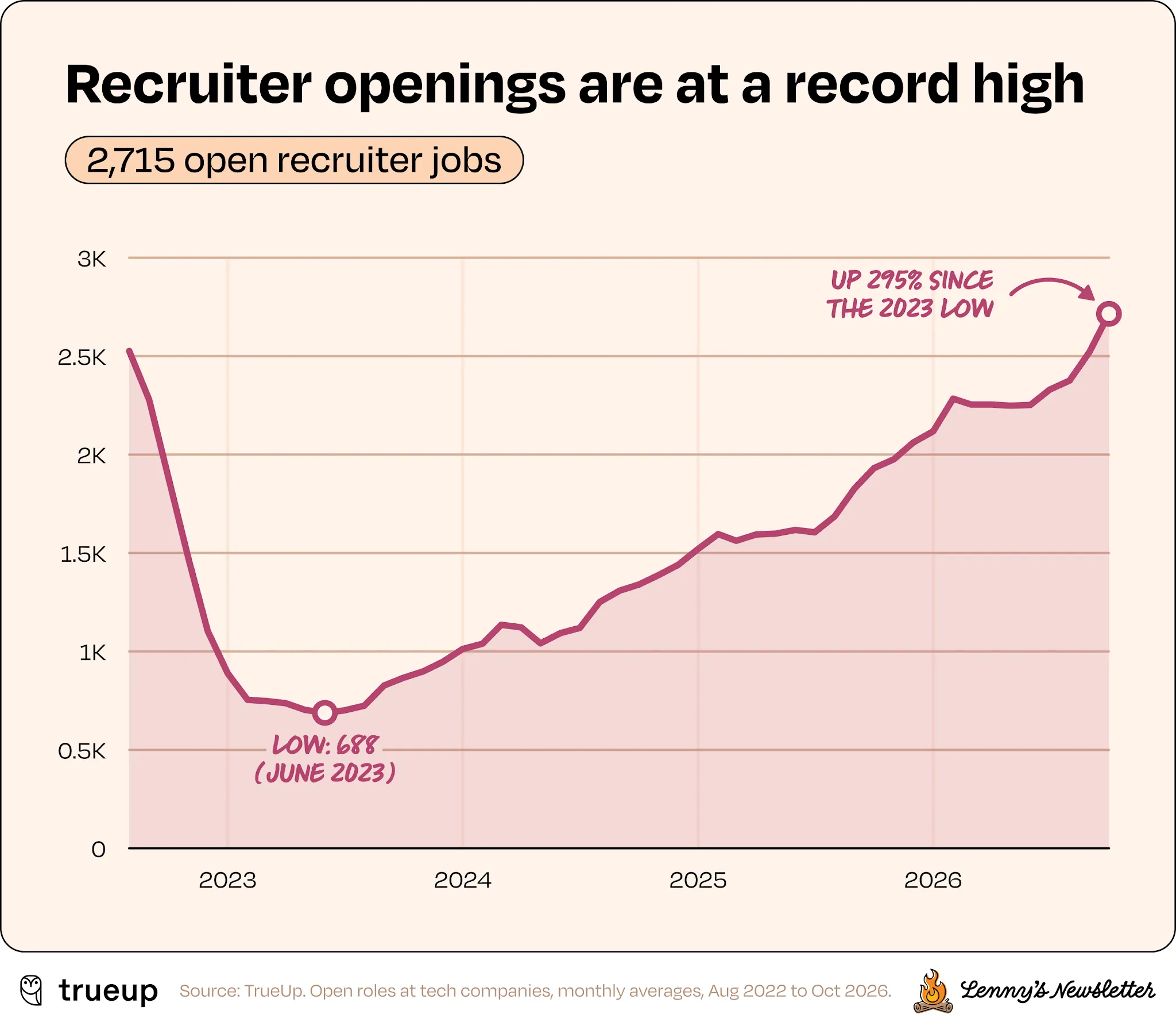
And who the f*** are recruiters hiring then? Open recruiter roles are at a record high: 2,715, up 295% since the low of June 2023.
Lenny reads it as an early sign that engineering hiring will pick up again. His last point says the tech job market is growing fast, but mostly outside software. And a posted job is not a hire: since January 2024, open engineering roles grew 44% while engineers hired fell 17%.
His report shows the blur too, only with engineers. Openings for mobile and front-end engineers nearly halved in a year, which he puts down to “the collapse of specialized/siloed engineering disciplines”. And part of the boom in forward-deployed engineers is sales engineers with a new title. Same work, new label.
It’s on me
This is all my engagements, every case study on this site: EDGE, HelloGov, Public Grid. It’s me sitting there watching PostHog sessions, understanding the customers, understanding the issues, understanding what we are doing next.
Didn’t deliver on the metrics? It’s on me. Solved the customer’s problem? It’s on me. The success of a feature launch? It’s on me.
I never understood the PM role
To be honest, I noticed this line was gone a long time ago, because I never understood the role of a product manager. It’s the weirdest role. The only reason product managers exist is that designers never wanted to take on a managerial role. They always wanted a seat at the table, but they never wanted the manager’s job. They just wanted to sit there and push pixels.
Who is a product manager? Someone who runs daily standups. For what? People are autonomous. You decide on the goal and what we’re building, and everyone goes and builds, delivers and tracks the metrics. That’s it. It is that simple.
Even when I worked at Apollo, I kept asking: what is the role of the PM? They sat in meetings all day long, discussing stuff and throwing tasks around. Nothing but a middle management layer. If you want speed and you want to actually move things, you need people focused on building the product.
The structure was always there
I agree that sometimes it helps to have a person focused on one thing, user research for example. But now the roles are more demanding, because everyone wants somebody to do everything: the user research and the user interface. Nobody has resources. Everyone wants to move fast, be lean, be agile. So the lines are blurry.
User research shows it best. Only about 1,800 user researchers were hired in the US in the past year, down 66% from 5,300 in 2022, and there are just 108 open research roles at tech companies worldwide. The research still happens. Someone else does it now.
The chaos is bigger, but the structure was always there. The roles have always been there. It all depends on the organisation. Some respect the roles and are doing great. Some don’t respect them and are also doing great. And some, either way, are doing worse.
Design is not disappearing
Design is not disappearing. It’s just a blurry state we are in right now. To be honest, it’s a very strange state, and I find it hard myself that anyone can now go and prototype something real quick. Good for them. In spring 2026, Claude became the second most-mentioned skill in design job posts, after Figma.
But my job was never to deliver the UI. My job was always to deliver solutions. For example, I don’t live in Figma anymore, because it was never about the UI. I live in the code, because it helps me stay close to the truth of what’s out there in the product.
The role of a designer is to bridge the gap between business needs and customer needs, and then build what needs to be built.
Call it whatever you want
Lenny hopes this turns around, because “great design can be a huge differentiator”. Honestly, I would say this to the CEOs more than to the designers. Asking one person to do everything is a short solution to a bigger problem. If you really want to excel at user experience, you need people who specialise in it.
At the same time, metrics are important. Delivering on the user experience is what actually moves the needle. It’s what moves the business. If I come in and solve the problem that users can’t get through sign-up in the onboarding, that’s a better onboarding. That’s a higher conversion rate.
At HelloGov, the first step asked people to choose a passport service, and it was a wall of text. I just added icons, because a list is much easier to scan with icons. New passport orders went up 23%.
That’s the goal of a designer, a manager, a product manager. Call it whatever you want. You find the problem, you find the solution, you deliver on it. Done.